

Flood Damage Cleanup in Leesburg, FL
On the Harris Chain of Lakes, the wind gets a running start but the water is what stays behind. A storm coming off Lake Harris or Lake Griffin crosses miles of open surface with no ridgeline, no tree wall, and no neighboring rooftop to slow it, so it reaches Leesburg's near-lake rooflines at close to full strength and works straight into the mature shade canopy and the older roofs underneath. The wind is only the delivery, though — once a gust lifts a stretch of aging shingle or a limb opens the deck, the storm starts pushing rain sideways through that gap, and at the same time the rain still falling soaks the low near-lake lots until the water finds its way under the doors and across the floor. By the time the chain calms back down, the loss in a Leesburg home is rarely the wind you heard overnight. It is the storm water sitting in the structure, and that is the side of the storm we clean up.
Start your restoration
We’re on it.
A Paul Davis dispatcher will call you within minutes. Keep your phone nearby.
Need to talk now? Call us directly
Storm Flood Damage Cleanup for Leesburg and central Lake County
Serving Leesburg and all of Lake County, FL.
Storm flooding is a different animal from a burst supply line, and most Leesburg homeowners underestimate it. Water that has crossed a saturated lakeside yard, run off the street, or backed up out of the ground is contaminated — Category 3 under the standard, the kind that has to be extracted and decontaminated, never just mopped. It does not stay where you can see it either: it wicks up the drywall of an older home, soaks the sill plates and insulation, and pools in the wall cavities and under the slab where Lake County's humidity keeps it warm and working long after the puddle on the floor is gone. Paul Davis treats the water side of a storm as its own emergency. We pump and extract what came in, decontaminate every surface and cavity it reached, then dry the structure with industrial equipment until it reads dry on a meter — not until it merely looks dry to the eye.
We run our storm operation from a Belleview base, which keeps us close to Leesburg and the towns around the chain — Tavares, Eustis, Fruitland Park — when a system parks overhead and the water keeps rising after dark. Storm flooding rarely waits for business hours; the low lakeside lots go under in the heaviest bands, often overnight, so we surge crews and roll extraction trucks within the hour. If storm water has pushed into your home or business, our team is ready around the clock.
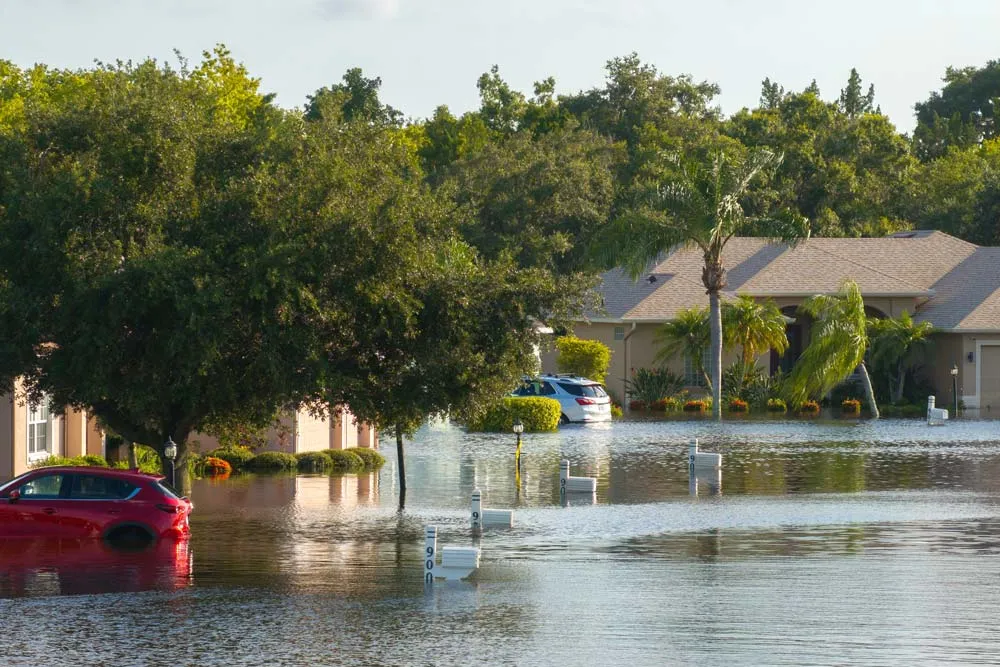
Why Leesburg homeowners call Paul Davis for storm flood damage cleanup
When storm water pushes into your home off the Harris Chain, you need one team that can extract and decontaminate it tonight and still be the team that dries the structure and rebuilds what the flood ruined. Paul Davis runs the entire job — pump-out, decontamination, drying, and reconstruction — from a Belleview base close enough to Leesburg to move the moment the water rises.
- Certified restoration technicians on every job — not general laborers
- 60-minute emergency dispatch, 24/7/365
- Direct insurance billing with most major Florida carriers
- Thermal imaging and moisture mapping on every inspection
- Guaranteed workmanship
Had a foundation leak, my flooring had to be taken up and replaced, as well as the kitchen. Though the process was long, due to insurance, Paul Davis kept fighting to get things right. Thank you to Tammy, John, Jeff and crew that made it all happen.
What puts Leesburg homes at risk
Every restoration job starts with understanding the local conditions that made it worse. These are the factors our crews see repeatedly across Leesburg properties.
Low near-lake lots on the Harris Chain
Homes ringing Lake Harris and Lake Griffin sit on ground that already drains toward the water, so when a storm dumps hours of rain the lower lakeside lots take on sheet water with nowhere to send it. That water presses into the home under the doors and up at the slab, which is exactly the intrusion we extract, decontaminate, and dry before it wicks deeper into the walls of an older Leesburg house.
Open lake fetch opening the roof to rain
Wind that crosses the open surface of the chain hits Leesburg's near-lake rooflines with nothing having slowed it, lifting aging shingle and working the deck loose on the lake-facing side. Once that envelope is breached, the storm drives rain sideways into the attic and down through the ceilings — a second flood from above that we trace, extract, and dry alongside the water that came in at floor level.
Older homes that hold water out of sight
Much of Leesburg's housing is older, and decades-old drywall, sill plates, and slab edges soak up storm water and hold it where you cannot see it. We map the full footprint with thermal imaging and moisture meters rather than assuming the water stopped at the visible line, then open and dry the cavities to a reading so nothing stays wet behind a finished wall.
Contaminated Category 3 floodwater
Storm water that has crossed lakeside yards, the street, or septic ground around the chain is contaminated blackwater, not clean rain by the time it reaches a Leesburg floor. We handle it as Category 3 — extracting it, decontaminating every surface and cavity it touched, and drying the structure under IICRC standards instead of treating it like a simple spill.
What to expect, step by step
Certified restoration technicians on every job, direct insurance billing, and daily updates from first assessment through final walkthrough.
Secure the property
We arrive first to stop more water getting in — tarping any roof breach the storm opened off the lakes and boarding up openings — so the flooding inside is not still being fed while we work the water.
Assess the full scope
We walk the structure with thermal imaging and moisture mapping to trace how far the storm water traveled — into wall cavities, under the slab, behind the baseboards — not just where it shows on the floor.
Pump out and extract the water
We pump standing storm water and extract what soaked into floors and walls fast, because every hour Category 3 floodwater sits in a Leesburg home drives it deeper and raises the mold risk.
Decontaminate and dry the structure
Storm flooding is treated as Category 3 — we decontaminate the surfaces and cavities it touched, then dry the structure with industrial equipment per IICRC standards until it reads dry on a meter, not just looks dry.
Remove debris and clear what the storm left
We haul out the ruined contents, soaked flooring, and any storm debris and downed limbs around the structure so the building can be properly evaluated for repair.
Repair and rebuild
As a licensed Florida general contractor, we rebuild the flooring, drywall, baseboards, and interiors the floodwater ruined — returning your Leesburg home to pre-loss condition under one accountable scope, only after it is fully dry.
In Depth — Leesburg
Flood Damage Cleanup in Leesburg: What Property Owners Need to Know
Ground-level storm flooding
Rain-driven sheet water builds in the yard and pushes into the home under doors and up through the slab, soaking everything at floor level.
This is the storm-water loss that hits Leesburg hardest — low lakeside lots ringing Lake Harris and Lake Griffin taking on water during a stalled storm band that has nowhere to drain. We pump and extract the intrusion, decontaminate the surfaces it crossed, and dry the slab and walls of an older home under IICRC standards before any rebuild begins.
Wind-driven rain through the roofline
Storm wind off the open lakes opens an aging roof, and rain forced sideways through the breach saturates the structure from above.
On Leesburg's near-lake streets the wind hits the roofline at near-full force after crossing the chain, and the rain that follows runs down through the attic into ceilings and wall cavities. We trace where that water actually traveled with thermal imaging, extract it, and dry the structure to standard so it never has the chance to start a mold problem.
Category 3 contaminated water
Floodwater that has crossed yards, streets, and septic ground carries contaminants and is treated as Category 3 blackwater.
Storm water moving across the lakeside yards and septic ground around the Harris Chain is never clean rain by the time it reaches a Leesburg floor. We handle it as the biohazard it is — full extraction, decontamination of every cavity it touched, and structural drying to standard, not a wet-vac and a fan.
Mold and Your Health
Storm floodwater is nothing like the clean water from a burst pipe. By the time it reaches your floor it has crossed lakeside yards, streets, and septic ground around the chain, so it is treated as Category 3 — a biohazard that needs proper extraction and decontamination, not a wet-vac and a fan. Left in the baseboards and wall cavities, it turns to mold within a couple of days in Lake County's humidity, which is why we tarp any roof breach immediately to stop further intrusion and dry the structure to standard before we rebuild. Getting the contaminated water out fast is as much about protecting your family's health as it is about saving the older home around them.
Certification & Insurance
Paul Davis is a licensed Florida general contractor, which is why we can do more than pump out a flooded home — we dry the structure and rebuild the flooring, drywall, and interiors the storm water ruined under one accountable scope. Our restoration technicians are certified to IICRC standards, the extraction, decontamination, and drying benchmark Lake County adjusters and Florida carriers recognize, and our crews are EPA Lead-Safe certified for the older near-lake homes common across Leesburg.
What to tell us when you call
Four things that speed up your claim
Type of damage — general location in the home — whether the source is still active — whether the building is safe to enter. We handle everything else.
Commercial Property Restoration
Storm flooding fills Leesburg's businesses as fast as its homes — the downtown storefronts, the offices, and the lakeside businesses along the chain where an inch of contaminated water across the floor shuts down operations. Paul Davis pumps and extracts at commercial scale, decontaminates the Category 3 water, then runs structural drying and full reconstruction on a timeline built around getting you back open. We coordinate directly with commercial adjusters and property managers so the cleanup does not stall.
When storm water floods your building anywhere in Lake County, Paul Davis is the single team that extracts it, dries it, and rebuilds it.
Why storm flooding in Leesburg is rarely just the water you can see
The puddle on the floor is the smallest part of a storm flood. By the time you notice water across the floor of an older near-lake Leesburg home, it has already wicked up the drywall, soaked the baseboards and sill plates, and slid into the wall cavities and under the slab where you cannot reach it. Mop the floor and the structure stays wet, and in Lake County's humidity that trapped storm water turns to mold within a couple of days. So we work the way the water actually behaves: map the full footprint with thermal imaging and moisture meters, extract what is standing, then pull flooring and open cavities where the readings tell us to and dry them to standard. A flood that gets dried halfway is a flood that comes back as a mold problem — which is why the water side of every storm gets the same discipline we bring to all of our storm damage work around the chain.
Drying and decontaminating one storm, under one roof
The hardest part of storm-flood recovery in an older Leesburg home is not the water you bail out the first night — it is the contamination and moisture that keep working after the chain calms down. Floodwater that crossed the yard or backed up out of the ground carries bacteria into the structure, and the rain that came in through a lifted roof soaks framing, drywall, and insulation that will grow mold within days if no one dries it properly. We treat the intrusion as seriously as anything the wind did, the same standard behind our dedicated water damage restoration in Leesburg. Because Paul Davis is a licensed Florida general contractor, the same company that extracts and decontaminates your flooded home also rebuilds it — the flooring, drywall, baseboards, and finishes the storm water ruined. You are not handed off to a separate builder weeks later, and nobody rebuilds over a wall that is still wet.
Disaster doesn’t wait.
Neither do we.
Storm water rises in the heaviest bands, and on the Harris Chain those tend to roll through after dark — which is exactly when we move. Our crews surge from the Belleview base the moment a system parks over Lake County, rolling pumps, extraction trucks, and board-up gear to Leesburg around the clock so the floodwater is coming out before it wicks any deeper. Call any hour during or after the storm — we dispatch within 60 minutes, 24/7/365.
Florida Emergency Hotline — 24 hours a day
Request a Free Estimate →Local department contacts
After major damage in Leesburg, you may need to reach a local department — the building office for permits and structural inspections, the health department for mold or contamination questions, or fire-rescue for a fire-damage assessment. Here are the offices serving Leesburg. Paul Davis is always one call away and can help you navigate the process.
Building Department
City of Leesburg Building Division
204 N 5th St, Leesburg, FL 34748
(352) 728-9735Health Department
Florida Dept of Health — Lake County
2113 Griffin Rd, Leesburg, FL 34748
(352) 589-6424Fire Department
Leesburg Fire Department (non-emergency)
201 S Canal St, Leesburg, FL 34748
(352) 728-9780Contact information is accurate to the best of our knowledge at time of publication. Paul Davis Restoration is not responsible for changes to agency contact information, hours, or services. For the most current information please contact the agency directly.
Frequently asked questions
You do not have to be lakefront to take on storm water around the Harris Chain. The ground here already drains toward the lakes, so when a storm dumps hours of rain the lower lots fill with sheet water that has nowhere to go and presses into homes under the doors and up at the slab. At the same time, wind off the open water can lift an older roof and let rain pour in from above, so the flooding often comes from two directions at once.
Yes, and it matters a great deal. Water that has crossed your Leesburg yard, the street, or septic ground around the chain is contaminated Category 3 blackwater, not the clean water from a supply line. It has to be extracted and decontaminated by certified technicians — wiping it up with towels leaves bacteria in the structure and a mold problem a few days behind it.
Almost certainly. In an older Leesburg home the water you can see is only part of it; storm water wicks up the drywall and pools under the slab and inside the walls, where Lake County's humidity keeps it working. We map the hidden moisture with thermal imaging and dry the cavities to a meter reading, because a flood dried halfway comes back as mold.
We dispatch within 60 minutes, 24/7/365, and our Belleview base keeps us close to Leesburg and the towns around the chain like Tavares, Eustis, and Fruitland Park. When a system stalls over Lake County we surge crews and run pumps and extraction trucks around the clock, because the low lakeside lots usually go under overnight in the heaviest bands.
Both, and that is the point of a full service. Because Paul Davis is a licensed Florida general contractor, the same team that extracts and decontaminates the floodwater also dries the structure and rebuilds the flooring, drywall, and interiors it ruined. You are not coordinating a cleanup crew and a separate builder after the storm.
Storm flooding in Leesburg?
When storm water pushes into your home or business off the Harris Chain, you need one team to extract it, decontaminate it, and rebuild what it ruined. Paul Davis runs the entire job from a Belleview base, close to Leesburg and ready the moment the water rises. Call now and we will dispatch a certified crew within the hour.